


FOR IMMEDIATE RELEASE
New Report Applies Historical Pattern Analysis to AI Employment Disruption
SynED Analysis Examines What Past Disruptions Reveal About the Transition Ahead
From the Industrial Revolution to the dot-com bust, technological disruptions follow recognizable patterns—but the speed and breadth of AI may be unprecedented
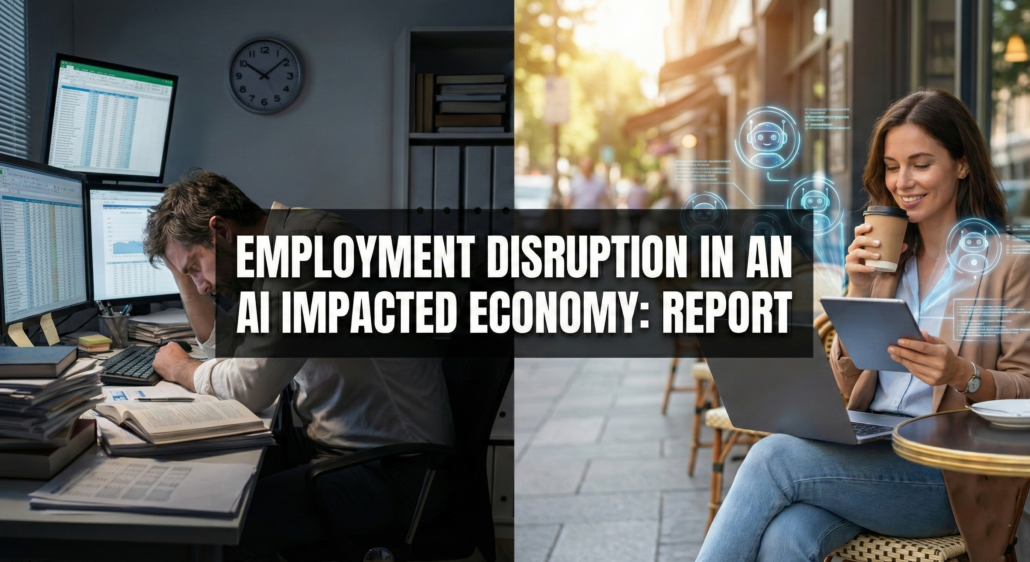
THOUSAND OAKS, CA (January 9, 2026) — A new report from SynED offers a different way of thinking about AI’s impact on employment—one grounded in the recognizable patterns of past technological disruptions rather than speculative projections. The analysis, titled “Employment Disruption in an AI Impacted Economy,” synthesizes lessons from the Industrial Revolution, the engineering collapse of the 1980s, the dot-com boom and bust, and the smartphone era to frame what workers, educators, and policymakers might expect in the years ahead.
“The purpose of this report isn’t about being right,” said Scott Young, Executive Director of SynED and lead author. “It’s about thinking differently about something that is moving so fast and disorienting so many people. When I started examining historical patterns, the familiarity was striking—and sobering.”
The Pattern: Front-Loaded Displacement
The report identifies a consistent pattern across major technological transitions: job displacement is front-loaded into a “hump” at the beginning of disruption, accumulates as workers struggle to adapt, then gradually fades as retraining takes hold or affected workers exit the workforce. The arcs are never straight lines, and aggregate projections that show net job creation obscure the human cost of the transition period itself.
Drawing on NBER research comparing 1,993 cities across six countries during manufacturing decline, the analysis finds that only 17% of US manufacturing hubs successfully recovered to prior employment levels—compared to nearly 50% of German hubs. The transition period, not the eventual outcome, determined whether communities thrived or entered decades of decline.
What Makes This Time Different
While the patterns are familiar, the report argues that the speed and breadth of AI-driven change may be unprecedented. Virtually every sector—commerce, medicine, infrastructure, military, professional services—is being transformed simultaneously by automation, robotics, and rapid problem-solving capabilities that fifty years of machine learning research made possible.
Previous technological revolutions primarily affected manufacturing or routine clerical work. Generative AI targets cognitive tasks performed by knowledge workers—traditionally among the most secure employment categories. Entry-level workers aged 22-25 in AI-exposed fields are already experiencing 6-13% relative employment declines, according to Stanford Digital Economy Lab research cited in the report.
The Education Question
The report examines whether education systems are preparing students for the transition—and finds a troubling mismatch. Education has systematically optimized students for rule-following, standardized performance, and convergent thinking, precisely where AI capability is highest. The skills that would make workers adaptable—divergent thinking, ambiguity tolerance, entrepreneurial agency—receive minimal systematic development.
“The transition gap isn’t primarily about capital or credentials,” Young noted. “It’s about agency—the psychological capacity to reinvent yourself when your career path disappears. That’s something education has been training out of students for generations.”
A Starting Point for Deeper Inquiry
SynED positions this report as the beginning of a broader research agenda. “This is a rich target environment,” Young said. “Point in any direction—healthcare, legal services, creative industries, manufacturing—and we can do a deep dive on how that sector will be transformed by synthetic intelligence and robotics. The patterns are there if we’re willing to look.”
Report Availability
The full 28-page report, including a detailed source appendix with over 100 credibility-weighted citations, is available for download at:
https://syned.org/employment-disruption-in-an-ai-impacted-economy